
Exposing the Consumer: How Fast Fashion Reshaped the Middle Class
There was a time when “Made in USA” or “Made in Canada” wasn’t nostalgic branding; it was normal. Clothing was manufactured locally. Factories employed entire communities. A minimum wage job could support a family, buy a home, and build a stable middle-class life.
Then the system changed.
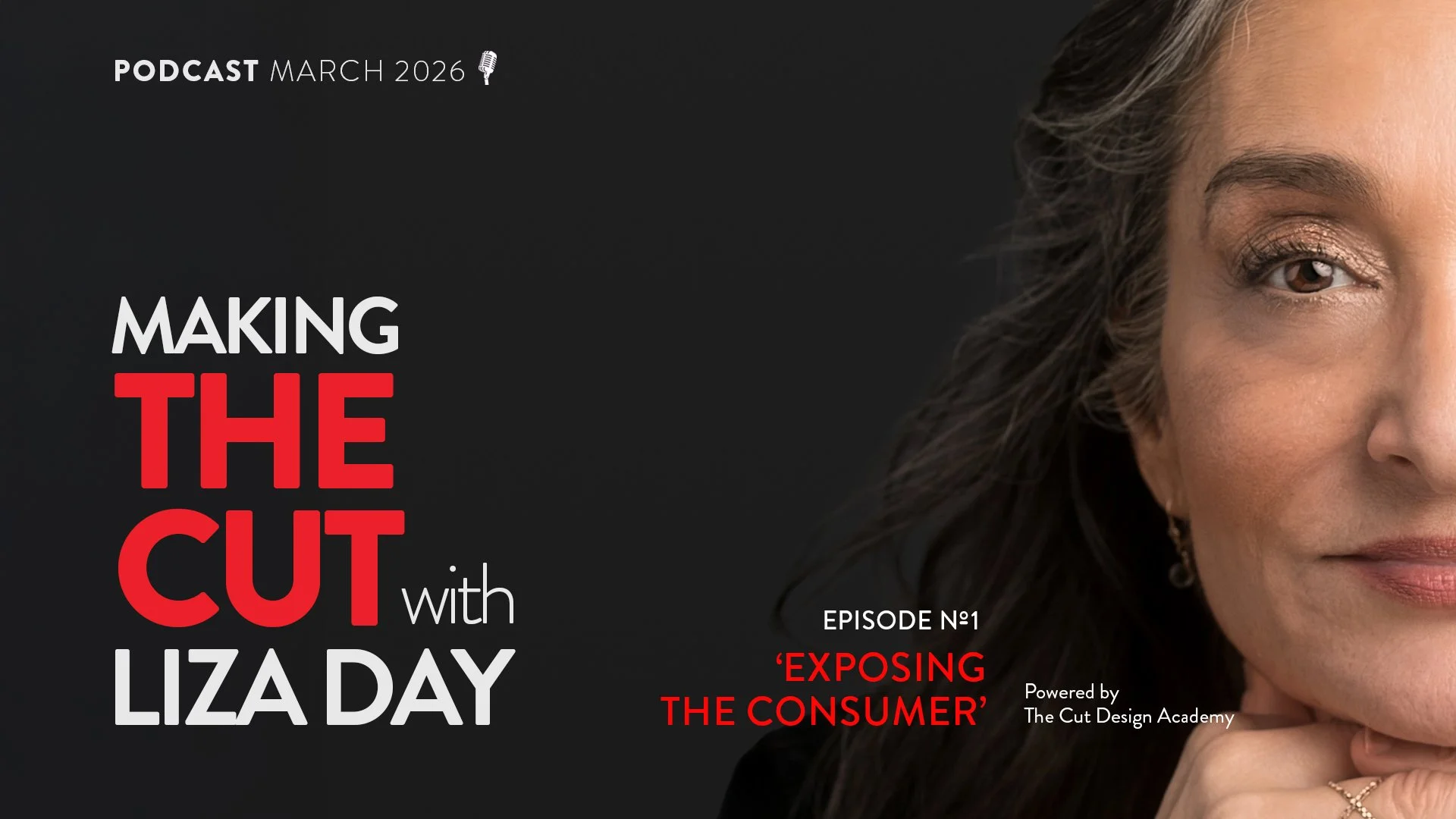
In her podcast episode Exposing the Consumer, apparel manufacturer and entrepreneur Liza Day reflects on the economic shift she witnessed firsthand inside the fashion industry, one that quietly transformed manufacturing, consumer culture, and ultimately the global economy itself.
As the Owner and Dean of The Cut Design Academy, Liza has spent more than three decades working across fashion manufacturing, product development, branding, and designer mentorship. Throughout her career, the emerging brands she worked with have been featured in WWD, InStyle, Glamour, and Harper’s Bazaar. She has also coached designers featured on Project Runway and helped launch a 13-year-old protégé’s fashion line into Nordstrom stores.
This isn’t just a story about clothing. It’s about how policy decisions, globalization, and consumer habits became deeply interconnected and how most people never realized it was happening.
The World Before Fast Fashion Took Over
Liza started her manufacturing business in the late 1980s. What began as a studio quickly evolved into a thriving factory producing garments domestically in Vancouver. By the mid-90s, the business had grown into a multi-million dollar operation employing dozens of workers earning livable wages.
At the time, manufacturing operated under something called the quota system.
Every country had limits on how much of certain products could be imported from overseas, whether textiles, furniture, plastics, electronics, or food. These quotas were designed to protect domestic industries and maintain economic balance.
According to Liza, that system shaped everyday life more than people realized.
“People could live a very comfortable life with two incomes, making minimum wage. You could buy a home, you could go on vacation, you could live life.”
And everything accelerated.
The Birth of the Fast Fashion Era
When quotas disappeared, companies rapidly scaled overseas manufacturing for North America. Production costs plummeted, letting brands produce more, cheaper, and faster than before.
This, Liza argues, is what allowed fast fashion to explode.
Companies like Zara, H&M, Gap, and Old Navy already existed, but after quotas vanished, their scale became almost unimaginable.
The economics changed completely:
The more companies that produced, the cheaper production became
Overproduction became financially beneficial.
Throwing away excess inventory became cheaper than manufacturing less.
Trends accelerated because constant consumption became the business model.
The environmental impact followed closely behind.
“Textiles have become the second largest pollutant in the world after oil.”
Regardless of debated statistics on fast fashion, the key reality remains: modern consumer culture relies on mass production, disposability, and endless consumption cycles.
According to the Ellen MacArthur Foundation, the equivalent of one garbage truck of textiles is landfilled or burned every second globally.
And consumers were trained to see this as normal.
How Manufacturing Became Associated With Exploitation
One of the most striking parts of Liza’s story is her perspective on the media narratives surrounding factories during the late 90s and early 2000s.
Television programs began heavily featuring exposés on sweatshops, particularly targeting brands like Nike.
But inside the industry, Liza says her experience looked very different.
She had operated factories for years and says she rarely encountered the extreme conditions the public was constantly shown. In fact, she points out that Nike was among the first companies to introduce strict approval systems for overseas factories, requiring standards around wages and working conditions long before many competitors did.
Her argument isn’t that exploitation never existed. It’s that the public narrative became simplified and that simplification served a larger economic transition already underway.
Manufacturing itself was framed as inherently unethical, while offshore production was simultaneously normalized.
The Disappearance of the Manufacturing Middle Class
For Liza, the deeper issue went beyond fashion. It was about labour.
It was what happened to labour.
As manufacturing moved overseas, North America gradually shifted from a production economy to a service economy. Entire categories of stable middle-class jobs began disappearing.
In the United States alone, apparel manufacturing employment has declined dramatically over the past several decades as production shifted offshore.
And according to her, minimum wage stagnated because companies no longer needed to compete for domestic manufacturing labour at scale.
The effects rippled outward:
fewer skilled trades
weaker wage growth
shrinking middle-class stability
A growing economic divide between ownership and labour
Meanwhile, consumers benefited from cheaper products, but often without seeing the larger trade-off happening beneath the surface.
That’s the central idea behind Exposing the Consumer: not blaming the consumer, but revealing the system they exist inside.
What Happens When Everything Becomes Disposable
The conversation eventually expands beyond clothing into food systems, ranching culture, land ownership, and consolidation.
While reflecting on time spent in Wyoming and Montana ranch communities, Liza draws parallels between manufacturing, agriculture, and globalization: once industries become fully optimized for scale and profit, local ecosystems’ economic and environmental health begin to erode.
The details may differ between fashion and food, but the pattern feels familiar:
consolidation
overproduction
lower costs
declining local independence
increasing concentration of power
Her perspective is ultimately less about conspiracy and more about interconnected systems.
Follow the money, she says repeatedly.
Why This Conversation Matters Now
The episode avoids labelling globalization as simply good or bad. Instead, it asks: What did we gain and what did we lose?
Consumers today have access to more products than any generation before them. Clothing is cheaper. Shipping is faster. Trends move instantly.
But at the same time:
local manufacturing has diminished
waste has exploded
wages have stagnated
Craftsmanship has become rare.
Disposability has become cultural.
And many people still feel financially squeezed despite living in an era of abundance.
Liza’s reflections challenge listeners to think more critically about the systems that shape everyday life, from the shirts in our closets to the structure of the modern workforce.
The One Industry That Still Feels Untouched
Toward the end of the episode, Liza shifts into something more personal: art.
For her, painting remains one of the few spaces that still feel unpredictable, uncensored, and genuinely human, not entirely controlled by corporate systems or mass-production models.
That sentiment quietly ties the entire episode together.
In a world increasingly optimized for scale, speed, and consumption, authenticity itself starts becoming valuable.
And maybe that’s what people are really searching for now.