
Digital Pattern Making: A Fifty-Year Shift, Not a New Trend
Pattern making rarely gets discussed the way the rest of fashion does. Nobody puts a pattern on a runway. But it's the discipline that decides whether a design becomes a wearable garment or stays a sketch, and it has been through a longer, more deliberate technological transformation than most people realize, one that started decades before anyone was calling it a trend.
A Longer History Than the Headlines Suggest
The shift toward digital pattern making didn't begin with a viral app. It began in 1973, when French engineers Jean and Bernard Etcheparre founded Lectra with a fairly narrow goal: getting a garment cut accurately, in every size, from a single cardboard pattern. By 1976, Lectra had built its first CAD systems for apparel manufacturing. By 1986, it was the world's leading provider of CAD and CAM systems for the industry. That's more than a decade of infrastructure-building before most designers working today were born, and it's the foundation the entire digital pattern making industry sits on.
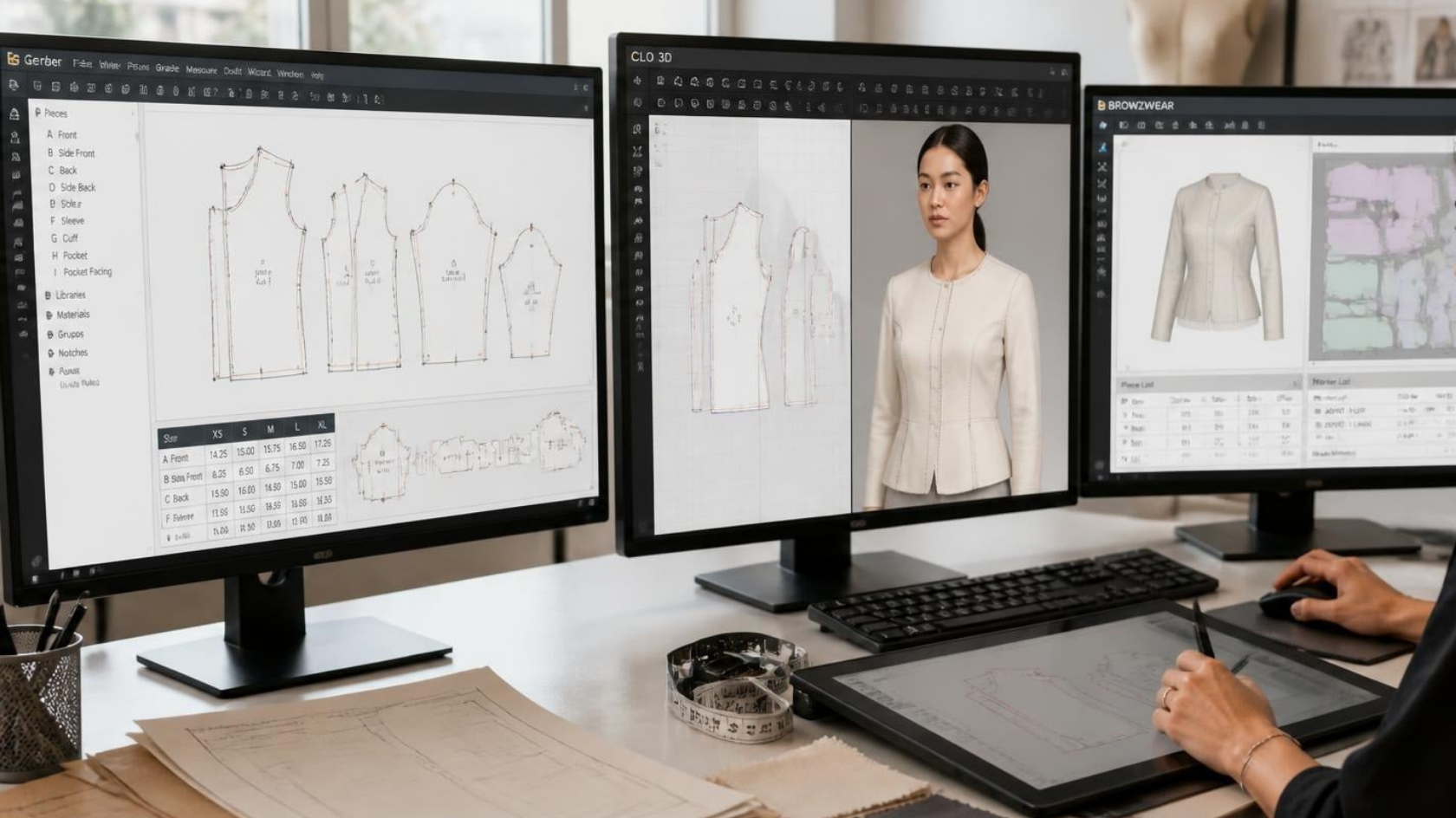
The next real leap came in 2009, when CLO Virtual Fashion was founded in Seoul by Jenne Oh, then a computer science student. The company's founders had identified a specific, expensive problem: fashion brands were discarding dozens of physical samples per finished garment, a process CLO's own research pegged at 20 to 30 percent of a typical company's prototyping budget. Their solution merged 2D pattern drafting with real-time 3D draping, letting a designer see how a pattern would actually behave on a body before cutting a single piece of fabric. By 2012, major brands had started adopting the software. Competitors like Browzwear and, more recently, Style3D built out the same category, and CAD pioneers like Lectra, which acquired Gerber Technology, kept evolving their own tools alongside them.
In other words: this is a fifty-year story of an industry slowly automating one of its most technical, least visible processes. The last five years haven't started that shift. They've accelerated it.
What's Actually Happening Inside the Software
It helps to be specific about what "digital pattern making" covers, because it's more than one step. A digitized pattern starts as 2D pieces drafted on screen instead of paper, using the same principles a hand-drafted pattern relies on: darts, seam allowances, grainlines. From there, grading, the process of scaling a single pattern up and down across a size range, happens automatically instead of through manual recalculation at every size. Marker making and nesting, arranging pattern pieces on a bolt of fabric to minimize wasted material, gets optimized by software rather than eyeballed by a cutter. And increasingly, the pattern gets draped virtually onto a 3D avatar programmed with a specific fabric's actual weight, stretch, and drape, so a designer can watch a garment move before it physically exists.
None of these steps replace the underlying skill of understanding how a garment is constructed. They change how fast a designer can test, fail, and correct that construction, which is a meaningfully different thing.
A Real Example: Tommy Hilfiger's STITCH Program
The clearest case study of what this looks like at scale is Tommy Hilfiger, which built an internal tech incubator called STITCH specifically to digitize its design process. The brand's stated targets were concrete: a capsule collection designed and sold entirely digitally by fall 2020, men's dress shirts that were "100 percent 3D designed" with no physical sample required, and a full transition to a 3D design platform in time for its Spring 2022 collection. More than half of the company's Amsterdam apparel divisions went through STITCH Academy training, with the plan extended to designers, pattern makers, and merchandisers across the company. This wasn't a marketing gesture. It was a structural change to how the brand builds a collection, expected to deliver sample reduction, time savings, and measurable sustainability gains.
The Numbers Behind the Urgency
There's a reason a company the size of Tommy Hilfiger commits real infrastructure to this. An estimated 35 percent of the material entering fashion's supply chain becomes waste before it ever reaches a customer, and roughly one in five garments produced is never sold at all. Brands that have moved sampling into 3D report cutting material waste by nearly half and emissions by close to a quarter, largely by eliminating the practice of shipping physical samples across the world for approval at every stage of development. Combine that with CLO's original finding that physical prototyping alone can eat up to 30 percent of a brand's development budget, and digital pattern making stops looking like a design preference and starts looking like a financial and environmental necessity.
What It Means for Anyone Entering the Field Now
For a working designer, the practical consequence is that the job description has quietly split in two, and employers increasingly want both halves in the same person: someone who understands garment construction the way a traditionally trained pattern maker always has, and someone who can operate the digital tools an entire supply chain now runs on. A designer who only has one of those skills is walking into an industry that has, over the last fifteen years in particular, restructured itself around having both.
That's the actual argument for formal training in this area, not that digital tools are trendy, but that the industry's own development pipeline, from independent labels to companies the size of Tommy Hilfiger, has been quietly rebuilding itself around this hybrid skill set for over a decade.
It's also why The Cut Design Academy treats digital pattern making as core curriculum rather than an add-on, taught alongside traditional drafting rather than instead of it. Students interested in how this training is structured, and where it fits into a broader design education, can reach out to our admissions team at admission@thecutdesignacademy.com.