
Why 2026 Is the Most Important Year to Start Making Art
Something is happening in studios, community centres, and parks across Vancouver right now, and it is not what anyone predicted.
Life drawing classes are packed with people in their twenties. Plein air painting groups are showing up in Stanley Park and Queen Elizabeth Park on weekends. Art workshops in the city are selling out weeks in advance. A generation that grew up with every creative tool imaginable in their pocket has quietly decided that the most meaningful thing they can do is pick up a pencil and draw from life.
A Vancouver resident who had wanted to be an artist since childhood but spent years in a communications career finally pulled the trigger and enrolled in a fine art programme. She described spending up to eleven hours a day in the studio, completely absorbed, feeling more herself than she had in years.
That story is not unusual anymore. It is becoming the norm.
This is not nostalgia. It is not a trend cycle. It is a cultural correction, and understanding why it is happening tells you something important about where we are as a society and what art is about to mean for the next decade.
The New Art Renaissance Is Real
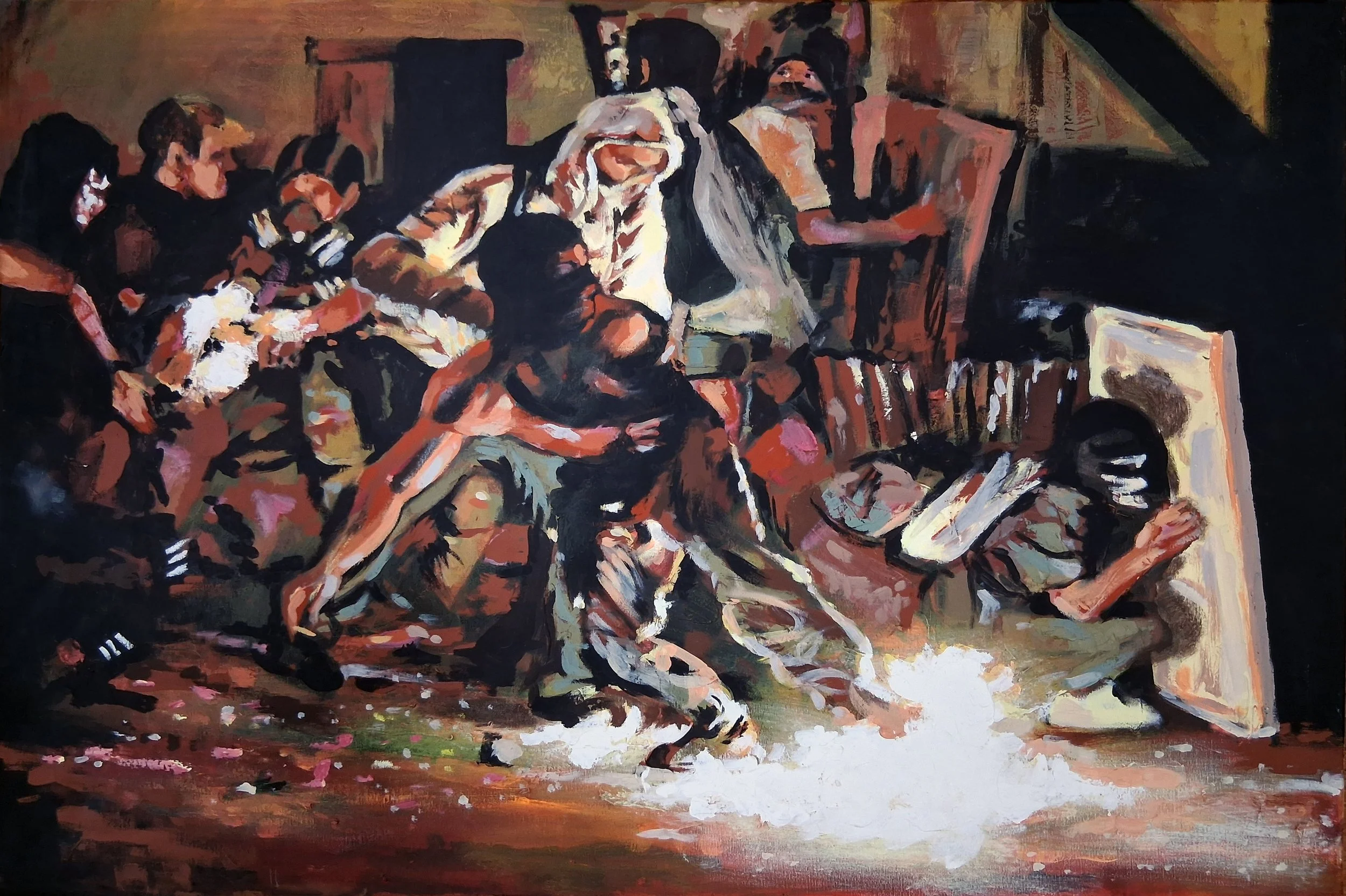
What is emerging in 2026 is a cultural shift back toward rich, human-made art after years of minimalism and digital saturation. Ornament, texture, figurative work, and visible process are returning, and collectors are choosing art with a real story and a real maker behind it.
Young artists are choosing real paint, real pencils, and real models to draw from. They are learning anatomy the old-fashioned way. They are hauling easels outside to paint what they see.
The reason is not hard to understand once you see it clearly. AI can generate a technically perfect image in seconds. It can replicate any style, any period, any aesthetic with algorithmic precision. What it cannot do is make something that carries the mark of a specific human hand, a specific moment of attention, a specific act of choosing to look at something carefully and respond to it honestly.
In a moment defined by technological acceleration and an oversupply of digital perfection, a quieter shift is taking place in studios everywhere. The art world is rejecting AI perfection in favour of visible humanity, emotion, and imperfection, with collectors paying premiums for work that unmistakably proves a human was here.
That phrase deserves to sit with you for a moment. A human was here. In 2026, that is no longer assumed. It has to be demonstrated. And the ability to demonstrate it, through drawing, painting, and digital art that carries genuine human intent, is becoming one of the most culturally valuable skills a person can have.
Why Gen Z Is Leading This
Millennial and Gen Z collectors now represent nearly half of all first-time art buyers, and their approach emphasises authenticity over status, experience over exclusivity, and meaning over market hype.
This generation grew up inside the algorithm. They have spent their formative years consuming content designed to maximise engagement, optimised for clicks and shares and watch time. They understand intuitively, even if they cannot always articulate it, what it feels like to be on the receiving end of content that was built to perform rather than to communicate.
Making art by hand is the direct antidote to that experience. Gesture drawing is like jazz: improvised, responsive, catching something that only exists in the moment. It offers everything AI cannot: spontaneity, intuition, a real-time response to something that will never happen exactly that way again.
There has been a 66% increase in sales for miniature and small-scale artworks suited for Gen Z apartments, and a surge in textured, imperfect, naive art styles that AI struggles to replicate authentically.
The market is confirming what the culture already knows. Human-made art, especially art that shows its process and its maker, is having a moment that does not look like it is going to end anytime soon.
Art as Therapy: The Dimension Nobody Talks About Enough
There is another conversation running underneath the cultural one, and it is equally important.
Vancouver is one of the most beautiful cities in the world and also one of the most expensive, most competitive, and most screen-dependent. The particular exhaustion of living a life mediated almost entirely through devices, meetings, and performance is something every person in this city knows.
What is less discussed is the growing body of evidence that making art, not consuming it, making it, with your hands, with materials, in real time, is one of the most effective tools available for restoring the sense of presence and groundedness that modern life systematically erodes.
Art therapy is a recognised clinical discipline precisely because the act of making something visual, of translating an internal state into an external form, does something that talking alone cannot always do. It externalises. It gives form to things that resist language. It creates a physical record of an inner experience.
But you do not need a clinical context to access those benefits. Picking up a sketchbook and drawing for twenty minutes produces measurable reductions in cortisol, the primary stress hormone. Sustained creative focus creates flow states, those rare periods of complete absorption where time disappears and the internal critic goes quiet. Finishing a painting, even a small one, even an imperfect one, produces a specific kind of satisfaction that scrolling through an endless feed of other people’s achievements simply never does.
This is why Vancouver’s art classes are full. This is why figure drawing nights have waiting lists. People are not just making art because it is trendy. They are making it because it makes them feel more like themselves.
Art and Design: The Connection Every Creative Needs to Understand
For anyone working in or studying design, whether fashion, interior, graphic, or any other discipline, the relationship between art practice and design thinking is foundational and deeply undervalued.
The ability to draw is not just a technical skill. It is a way of training the eye to see what is actually there rather than what you expect to see. Life drawing in particular, studying the human figure, understanding how mass and weight and light and shadow work together, develops an observational precision that changes how you design everything from a garment silhouette to a spatial layout to a typographic composition.
Colour theory learned through painting, through mixing pigments and watching how colours behave in relationship to each other, produces an understanding of colour that no digital tool can substitute. You learn not just which colours look good together but why, how they interact, how they shift depending on the light around them, how they affect each other at their edges.
Digital art connects the hand-made and the computational in a way that is directly relevant to every area of contemporary design. The ability to move fluidly between traditional mark-making and digital tools is increasingly what employers in every creative field are looking for, because it produces designers who understand both the why and the how.
Art is not a detour from design education. It is the foundation it is built on.
Something New Is Coming to The Cut Design Academy
We have been watching this cultural shift carefully, listening to our students and to the Vancouver creative community, and we are ready to respond to it.
The Cut Design Academy is launching a Drawing, Painting and Digital Art Certificate, and we want you to be among the first to know.
Whether you are a design student looking to deepen your creative foundation, someone who has always wanted to make art but never had the right structure to start, or a professional looking for a creative practice that reconnects you to why you chose this industry in the first place, this certificate is being built with you in mind.
Details are coming very soon. In the meantime, if you want to be the first to hear when enrolment opens, reach out to us at admissions@thecutdesignacademy.com and let us know you are interested.
The new art renaissance is already here in Vancouver. We are building the space for you to be part of it.