
The Difference Between a Portfolio and a Pile of Good Work
Most people preparing a fashion portfolio start the same way: they open a folder of everything they've made and pick the pieces they're proudest of. It feels like the right instinct. It's also, according to nearly every admissions officer and recruiter who has written publicly about reviewing portfolios, the thing that quietly sinks a lot of otherwise strong applications.
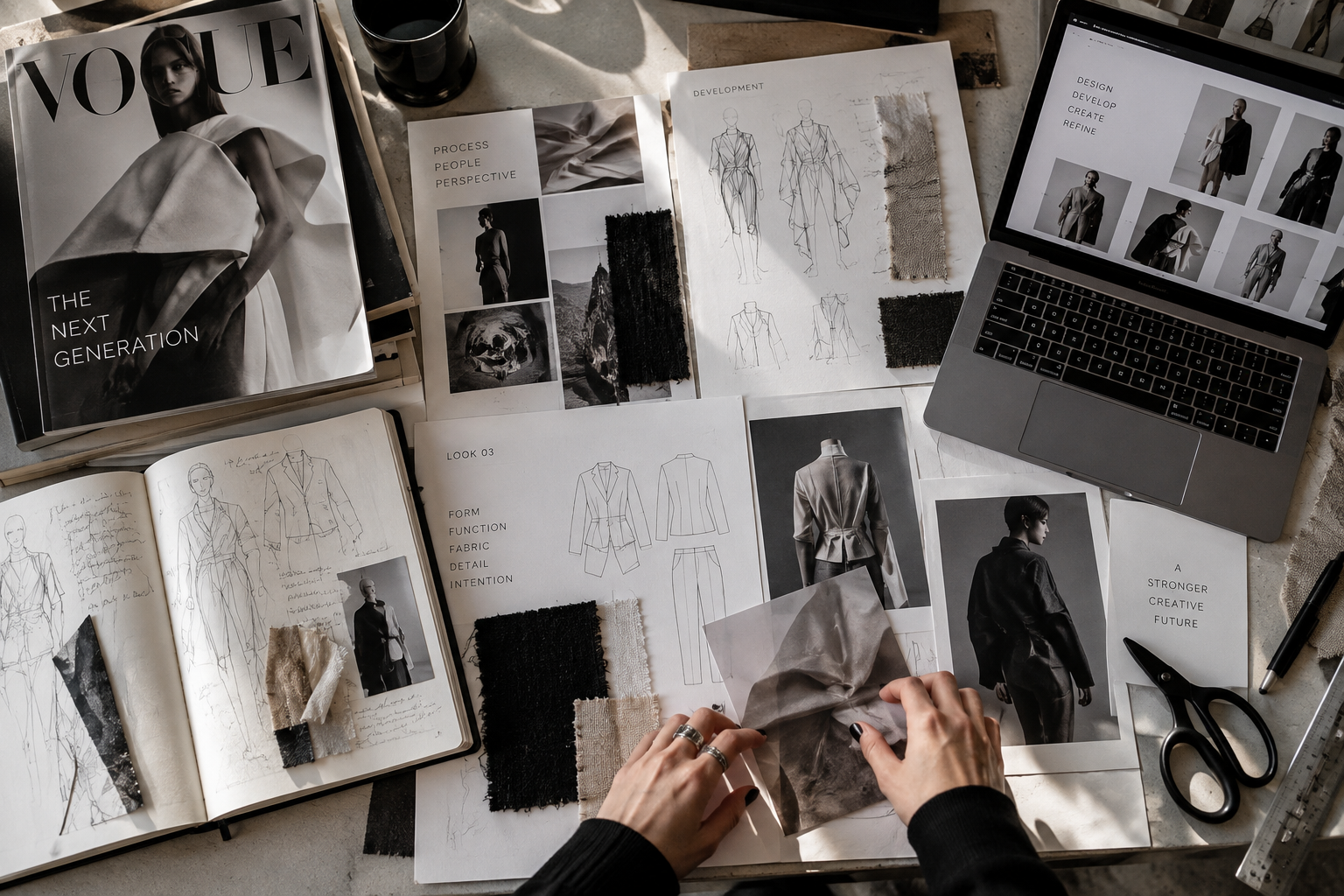
The problem isn't talent. It's that "my best work" and "a portfolio" aren't the same object. A pile of good pieces shows a reviewer that you can design well in isolation. A portfolio has to do something harder: prove something specific and coherent about you, to a specific reader, in the ten or so minutes they'll actually spend on it.
Why collecting isn't the same as curating
The University of the Arts London puts the selection test plainly: if you can't explain why a piece is in your portfolio, it shouldn't be there. That single rule eliminates more work than people expect, because "I liked how this one turned out" isn't an explanation a reviewer can use. What they're actually looking for is a piece that's doing a job, proving a technique, showing a direction of thought, demonstrating range in a specific area, and a portfolio full of pieces that are each individually good but collectively unrelated reads as indecision rather than range.
Le Mark Institute, which reviews fashion applications professionally, is more specific about the failure mode: portfolios that try to demonstrate every skill a designer has usually undercut all of them. Their advice is to build around two or three themes that reinforce each other rather than a "smattering of diversity," and to cut anything that doesn't support that throughline, even if it's good on its own. Nearly every source lands on a similar ceiling for size, somewhere around 8 to 15 pieces depending on the program, with the shared reasoning that a tightly edited set of 10 to 12 pieces consistently outperforms a bulkier one. The number itself isn't really the point. The discipline of hitting it is.
What a portfolio is actually supposed to prove
Istituto Marangoni describes a portfolio's job as telling a reviewer who you are as a professional, not just what you're capable of producing. That distinction breaks down into a few concrete things a strong portfolio needs to show, not just talk about.
Process is one of them, and it's the one most students actively hide. UAL's guidance is direct: include unfinished work, because it shows how you research and develop an idea rather than just how it ends up. A sketch that changes direction partway through, a fabric test that didn't work, a toile with notes on it, these aren't evidence of failure. They're the only evidence a reviewer has that you actually think through a design rather than arriving at it by instinct alone.
Technical ability is the second, and it needs to be visible, not claimed. For applicants to design programs, that often means specifics reviewers are trained to check for: hand-drawn figures rather than traced ones, real fabric swatches attached to illustrations, back views alongside front views, and finished garments photographed on a mannequin or model in a way that shows actual construction knowledge. For anyone applying to a working design role, technical proof looks different. Most corporate design work runs through CAD software day to day, so a portfolio built entirely around hand-rendered work, however skilled, can read as a gap rather than a style choice.
Creative identity is the third, and it's the hardest to fake. UAL's phrasing on this is worth sitting with: show a reviewer what you want them to see, not what you think they want to see. Portfolios built to guess at a reviewer's preferences tend to read as generic, because they are, structurally, built to avoid a point of view rather than express one.

The same portfolio doesn't work for every reader
This is where a lot of otherwise strong portfolios lose effectiveness, not because the work is weak, but because it's aimed at the wrong evaluator. Le Mark Institute draws a clear line here: student portfolios are evaluated primarily on concept and process, while industry portfolios are additionally judged on commercial viability, meaning whether the work looks like something that could actually be produced and sold. A portfolio built entirely around conceptual exploration, exactly what a further-education reviewer wants to see, can undersell a candidate applying for a job, where a hiring manager is also asking a more practical question: could this person's work fit into what we already make and sell.
The fix isn't building two separate portfolios from scratch. It's understanding which pieces to lead with and how to frame them depending on who's reading. Someone applying to further study can put process and experimentation at the front. Someone applying for a design role should lead with production-ready work and be explicit, in captions or a short note, about their individual contribution if any piece was collaborative, since vague shared credit reads as a flag to anyone who reviews portfolios regularly. Someone applying for an internship, without much formal work history yet, is often better served leaning on range and initiative, self-directed projects that show they can generate ideas without being assigned them, since that's usually the actual question an internship reviewer is trying to answer.
Why this is harder to do alone than it looks
Almost every mistake covered above traces back to the same root cause: a portfolio assembled under deadline pressure, by the person whose work is in it, without anyone checking whether it reads the way they think it reads. Curating your own work objectively is genuinely difficult. It's hard to know which of your pieces actually explain themselves to a stranger, which ones are quietly repeating the same idea, or which reader you're actually building for, without outside eyes and, ideally, more than one pass.
That gap, between knowing the principles and having the structured feedback to actually apply them, is what The Cut Design Academy's upcoming Portfolio Build offering is designed to address. It's built for people who already have some fashion education, whether they're finishing a diploma or have already graduated, and need to build or strengthen a portfolio for their next step, whether that's a job, an internship, or further education. If you're at that point and want to know more, our admissions team can be reached at admission@thecutdesignacademy.com.