
What Matthieu Blazy's Chanel Is Teaching Us About the Future of Fashion Identity
There is a question every serious design student needs to sit with right now, and it is not about which trend is winning this season. It is this: what does it actually mean to take over one of the most powerful fashion houses in the world and make it yours without destroying what made it sacred in the first place?
Matthieu Blazy is answering that question in real time. And the answer is worth studying closely.
When Blazy was appointed Chanel's Artistic Director in late 2024, the fashion world held its breath. Chanel was not just any house. It was the house. Decades of Karl Lagerfeld, codes so embedded in culture they had practically become law, a consumer base with strong opinions and the spending power to back them. Blazy's predecessor Virginie Viard had kept things steady, but steady had started to feel like stalling. Something needed to shift.
What nobody quite predicted was how precise the shift would be.
He Did Not Break the Code. He Bent It.
This is the first and most important lesson for any designer studying this moment.
Blazy's debut collection and the Fall/Winter 2026 follow-up both return obsessively to the Chanel suit, the single most recognizable garment code the house possesses. But he did not present it reverently. He loosened it. He rebuilt it in ribbed knits instead of rigid tailoring. He threaded tweed with lurex and silicone and gauze. He turned the iconic bouclé jacket into work shirts and blousons that carry the same relaxed ease as something you would actually want to live in.
The silhouette references moved through the decades deliberately, from the dropped waists of the 1920s to the sharper lines of the 1950s and back again, layered but lithe, worn untucked, worn with intention but not with ceremony.
This is what mastery looks like. Not destruction, not reverence. Dialogue.
As a designer, the skill being demonstrated here is the ability to identify which codes are load-bearing (the suit, the tweed, the two-tone shoe, the camellia) and which are merely habitual. Blazy kept the load-bearing ones and completely renegotiated the rest.
The Set Was Part of the Argument
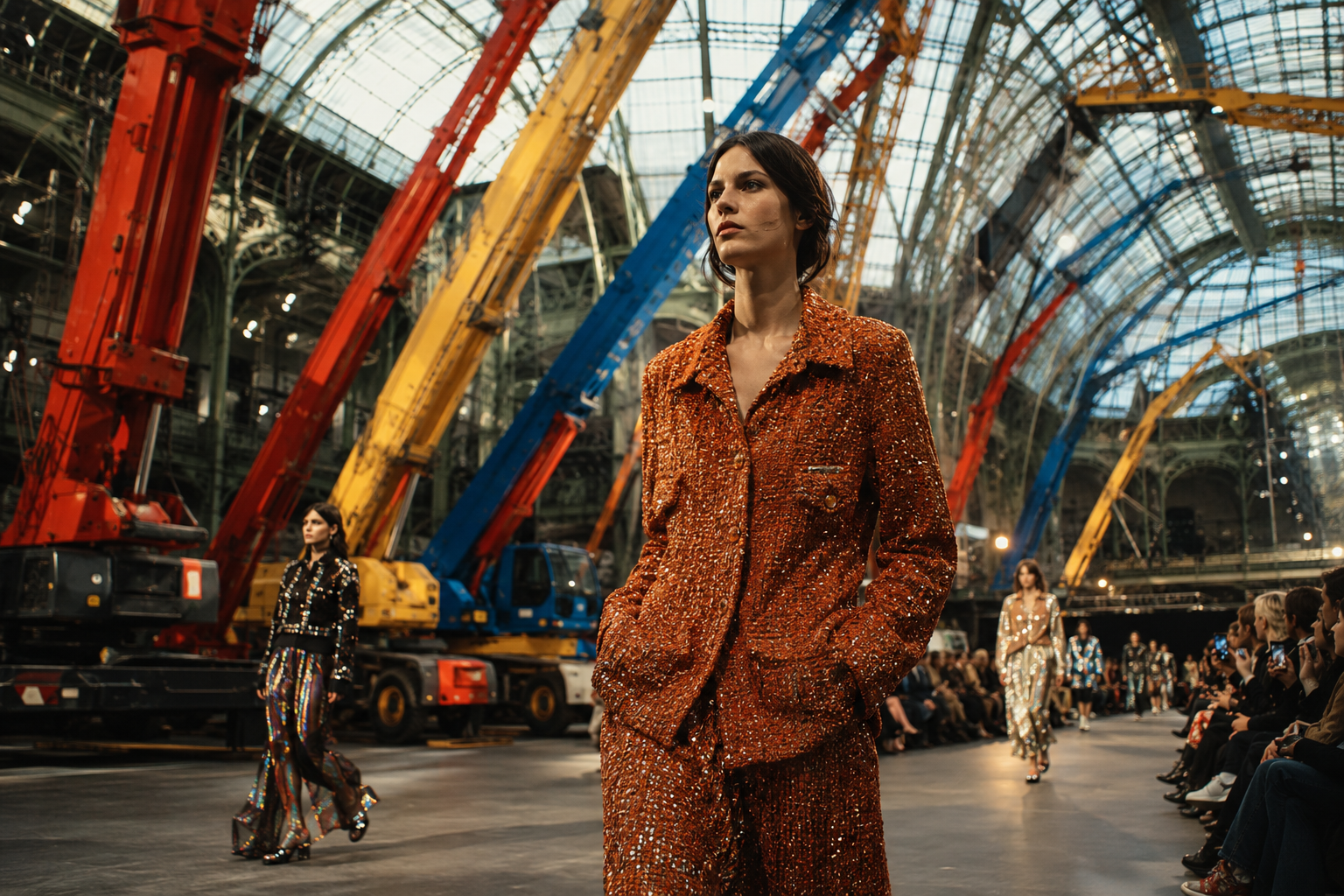
For the Fall 2026 show, Blazy filled the Grand Palais with towering cranes in lacquered primary colours, turning Chanel's most storied runway into a surreal construction site.
Before a single look appeared, the message was already landing: we are building something here. This is not finished. We are all works in progress.
Design students often underestimate how much a set communicates before the clothes do. The environment Blazy created did not just complement the collection, it gave the audience a framework for how to receive it. The cranes gave permission for the clothes to feel unfinished in the best sense, evolving, open. It reframed what could have read as imperfection as deliberate process.
This is something worth carrying into your own work. The context in which you present a design becomes part of the design itself.
The Fabric Is Doing the Heavy Lifting
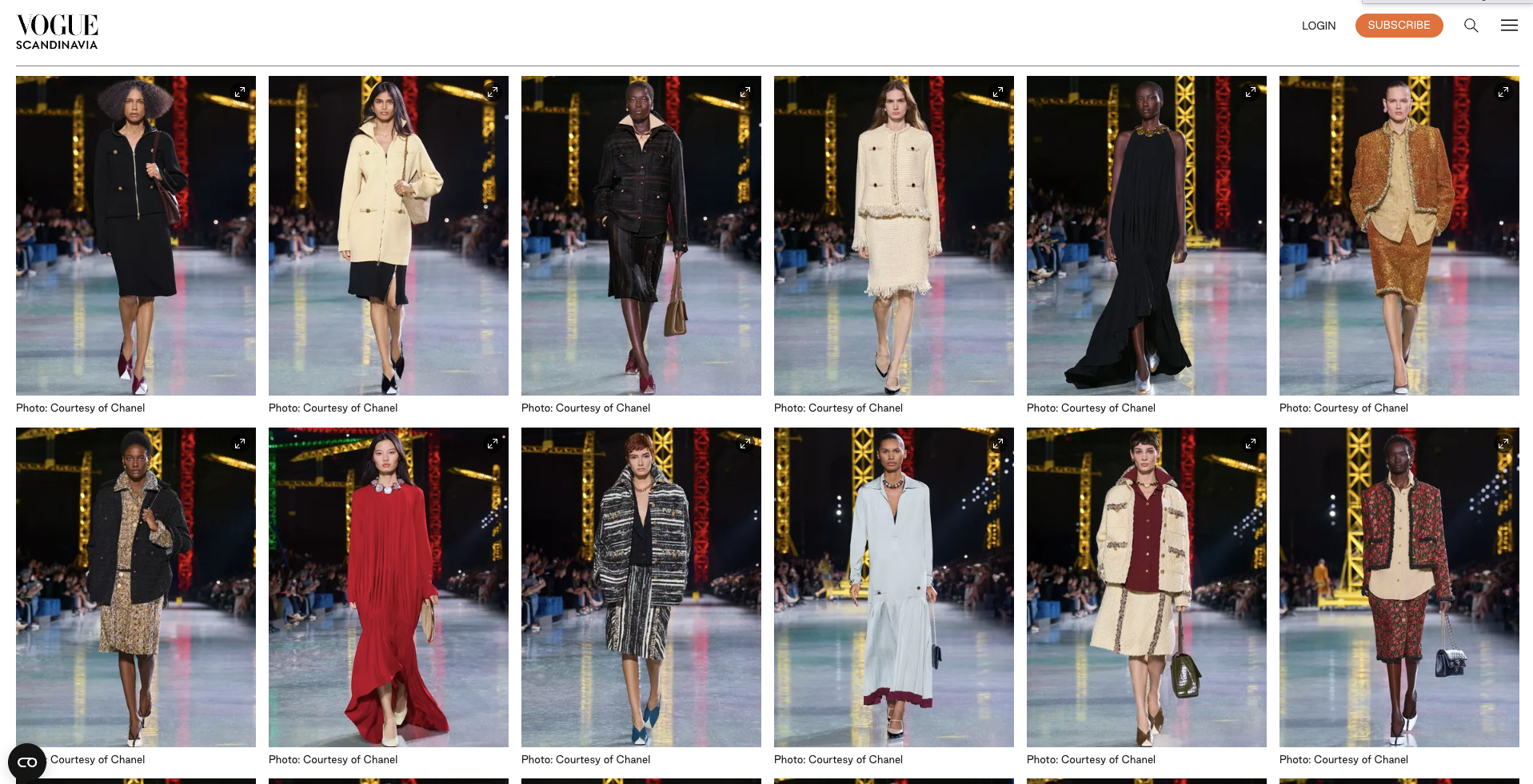
One detail that gets glossed over in the trend coverage but matters enormously from a craft perspective: Blazy's fabric choices are not decorative. They are structural to his argument.
The orange-gold tweed suit from FW26 is carpeted in micro-sequins, creating a surface described as closer to molten metal than textile. Silk jerseys appear alongside featherlight beaded knits. Iridescent fabrics blur the line between daywear and evening. The collection moves from grounded practicality to nocturnal shimmer not through silhouette changes alone, but through fabric behaviour.
This is Kering-level technical knowledge deployed in service of a storytelling arc. The clothes literally transform across the show, which is exactly what Coco Chanel herself described in the quote Blazy reprinted in his show notes: "Be a caterpillar by day and a butterfly by night. There is nothing more comfortable than a caterpillar and nothing more made for love than a butterfly."
The fabric choices make that metaphor literal. That is not styling. That is design thinking.
What "Chanel Is a Paradox" Actually Means
In his Fall 2026 show notes, Blazy wrote: "Chanel is function, Chanel is fiction. Chanel is sensible, Chanel is seductive."
On the surface this reads as a poetic brand statement. But for design students, it is actually a framework for understanding how identity works in fashion at the highest level.
A great house does not stand for one thing. It holds tension. It contains multitudes. The woman who wears Chanel is not one woman, she is the version of herself that exists before noon and the version that exists after midnight. She is the person who values function and the one who wants fiction. Blazy's job is not to pick one of those women and design for her. It is to create clothes that serve the full range of who she is.
This is the difference between a brand and a house. Brands flatten identity into a legible signal. Houses complicate it back into something real.
When you are developing your own design identity, this distinction matters enormously. The goal is not to be easily read. The goal is to be genuinely inhabited.
Why the Market Responded Immediately
Theory matters, but so does what happened when the clothes actually hit the stores.
Blazy's Spring 2026 two-tone V-vamp pumps sold out within days of arriving in boutiques. Insiders were queuing for hours at Rue Cambon and Le Bon Marché. Social media did not just report on the collection, it tracked purchases in real time. Lyst named Chanel the hottest brand of Q1 2026.
For students, this is not just a fun industry anecdote. This is proof that rigorous creative thinking and commercial performance are not in opposition. Blazy did not simplify his vision to sell more shoes. He deepened it, and the market followed.
The lesson is that consumers, especially at the luxury level, can feel when a designer believes in what they are making. That belief is not invisible. It shows up in the cut, in the fabric choice, in the decision to open a show with Lady Gaga's Just Dance and close it with a black jersey dress that quietly references the little black dress Coco Chanel invented 100 years ago.
It shows up everywhere, and it is worth everything.
What You Should Take Into Your Studio
Blazy's Chanel moment is not just a story about one designer and one house. It is a live demonstration of several principles that belong in every serious designer's working process.
Know the codes before you break them. You cannot have a productive conversation with a heritage you do not understand. Blazy spent years studying house archives. The looseness in his work comes from deep knowledge, not from ignoring what came before.
Context is content. The environment you create around your work shapes how it is received. This is true for a runway and equally true for a portfolio presentation, a lookbook, or an Instagram grid.
Fabric is not decoration. It is language. The material you choose communicates before the silhouette does. Develop your fabric literacy as seriously as your pattern-making.
Tension is not a problem to solve. The paradox Blazy describes, function and fiction, sensible and seductive, is not a contradiction to resolve. It is the point. The richest design identities hold more than one truth at once.
Build in public. The construction site set was not accidental. It was a statement that great work is not delivered finished from on high. It is made, unmade, and remade in front of the people it is meant to serve.
Fashion history is not behind us. It is being written right now, in Paris, by a French-Belgian designer who looked at the most powerful house in the world and decided the most radical thing he could do was make it feel human again.
That is the kind of work worth paying attention to. And more importantly, it is the kind of work worth learning how to do.