
When Fashion Entered the Museum as Art: What the 2026 Met Gala Taught Every Design Student
Every year, the Met Gala produces a lot of opinions. Best dressed, worst dressed, who played it safe, who swung too hard. The internet runs its usual cycle and by Thursday it is largely forgotten.
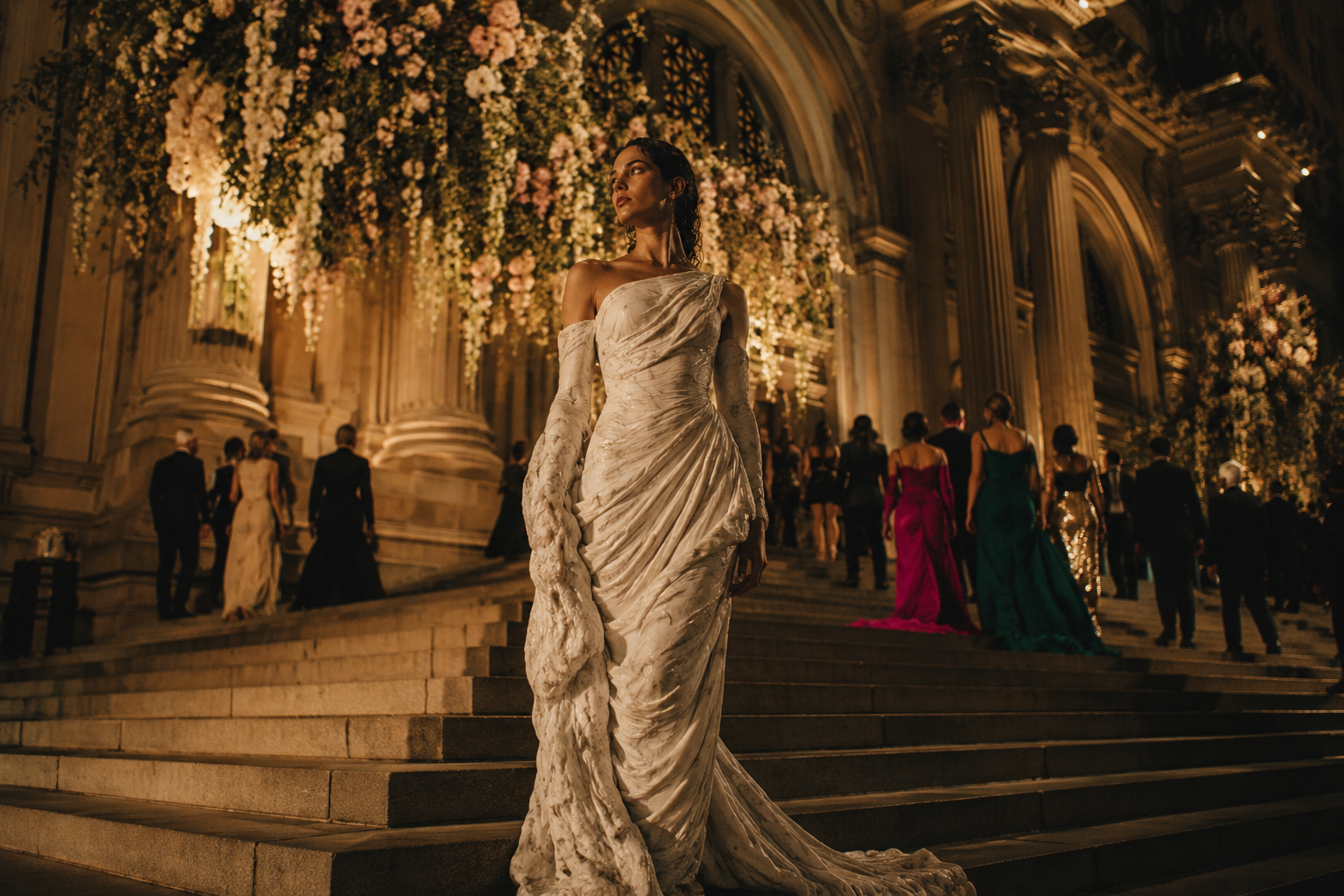
But the 2026 edition was different. Not because of the guest list, not because of the drama around the honorary chairs, and not because of any single iconic look. It was different because the theme, Costume Art, asked a question that designers at every level need to genuinely sit with.
What actually happens when fashion is treated not as decoration or commerce, but as art? And more importantly, what does your answer to that question mean for how you design?
What the Theme Was Actually Asking
The exhibition that anchored this year's gala was not a typical fashion retrospective. Curator Andrew Bolton paired almost 200 garments with artworks spanning prehistory to the present, from Albrecht Dürer prints to contemporary sculpture, and organised them not by era or designer but by body type. The nude body, the classical body, the pregnant body, the aging body, the anatomical body.
That last category is the radical one. Fashion exhibitions have historically done the opposite, removing the body to elevate the garment, presenting clothes on faceless mannequins under museum lighting so that the craft becomes the focus. Bolton's argument was that this approach fundamentally misunderstands what makes fashion different from every other art form.
"Fashion has the status of art because of, and not in spite of, its relation to the body," he said at the announcement press conference.
Read that again. The body is not a problem fashion has to work around to be taken seriously. The body is the entire point.
For design students, this reframes something that often gets treated as a technical constraint into something central to your creative identity. You are not designing clothes. You are designing the experience of inhabiting a body.
Three Looks That Were Actually a Masterclass
The red carpet delivered a range wide enough to illustrate every possible interpretation of the theme. Some guests wore art. Some became art. Some completely misread the brief. The most instructive were the ones who committed to a specific idea and followed it all the way through.
Heidi Klum as Veiled Vestal
Klum arrived as Raffaele Monti's 1847 marble sculpture of a veiled woman, rendered so precisely by makeup artist Mike Marino that she was entirely unrecognisable. Every visible part of her body was covered except her eyes.
This is the most literal possible interpretation of the theme, and it worked because the commitment was total. The craftsmanship in the prosthetics and body paint required the same level of technical precision as haute couture construction. But more than that, Klum made a conceptual choice that most designers miss: she did not wear the art. She became the art. Her body was not a canvas for the garment. Her body was the garment.
As a designer, the question this raises is worth keeping in your sketchbook: where does the garment end and the body begin? Klum's look argues that the boundary is more porous than we usually treat it.
Sabrina Carpenter and the Film Roll Dress
Carpenter arrived in a dress constructed from 35mm film strips from the 1954 Audrey Hepburn film also called Sabrina. The self-referential layers here are fascinating from a design theory perspective.
The garment tells a story about identity and inheritance. The name Sabrina connects her to a cultural artefact that predates her. The film strips as material transform something that typically stores images of bodies into a garment that now clothes a body. The medium became the message in the most literal sense.
What this demonstrates is how material choice can carry conceptual weight. The dress would have been completely different, and far less interesting, in any other fabric. The 35mm film was not a styling decision. It was the entire argument.
Lauren Sánchez Bezos in Schiaparelli
The Schiaparelli gown referencing John Singer Sargent's Madame X was one of the most discussed looks of the night, partly for reasons that had nothing to do with fashion. But strip away the context and what you have is a designer and client making a sophisticated choice about art history.
Sargent's original portrait of Madame Gautreau caused a scandal in 1884 because of how it portrayed a socialite in a low cut black gown with a fallen strap, the suggestion of impropriety rendered in paint. Schiaparelli's interpretation for 2026 did not copy the painting. It conversed with it, updated the silhouette and added statement pearls to the straps, turning what was once scandalous into something commanding.
This is the design skill of knowing your art history well enough to reference it with precision rather than pastiche. A reference only works when you understand why the original mattered.
The Looks That Missed and What They Tell You
Not every look landed. Several celebrities arrived in beautiful gowns that had no discernible relationship to the theme whatsoever, which in the context of Costume Art was actually a statement in itself, just not the one they intended.
The dress code was Fashion Is Art. It was broad enough that almost anything could qualify with the right intention behind it. What separated the successful looks from the unsuccessful ones was not spectacle or cost. It was whether the person wearing the garment had a point of view about what they were doing and why.
This is the lesson that transfers most directly into your studio practice. Technique without intention produces beautiful objects. Intention without technique produces interesting failures. The goal is both, and neither one substitutes for the other.
What the Exhibition Got Right That the Industry Often Gets Wrong
The inclusion of the pregnant body and the aging body as categories in Costume Art was the quietly radical part of the whole endeavour. Fashion as an industry has historically designed around a very narrow definition of the body, treating deviation from that definition as a problem to accommodate rather than a form worth celebrating.
Bolton's exhibition argument is that art has never had that limitation. Greek sculpture depicted bodies in every stage of life. Renaissance painting celebrated the pregnant form. The aged body has been a subject of portraiture across centuries. Fashion, by contrast, only recently began designing for the full range of bodies that actually exist in the world.
For design students entering the industry right now, this is not a diversity talking point. It is a creative opportunity. The bodies that fashion has historically ignored represent a vast and largely unexplored design space. The question of how fabric behaves differently on different bodies, how silhouette needs to shift to serve different proportions, how construction changes when the assumptions change, these are genuinely interesting design problems that the best designers of the next decade will need to understand.
The One Idea Worth Carrying Out of This
Fashion has spent decades trying to be taken seriously as art by distancing itself from the body, presenting itself in galleries, on mannequins, in museums, under the same lighting as paintings and sculptures, as if the corporeal were something to be embarrassed about.
Costume Art made the opposite argument. The thing that makes fashion irreducibly itself, the thing that no other art form can do, is that it is always worn. It always exists in relationship to a living person, a moving body, a specific life. That is not a limitation. That is fashion's entire power.
As Andrew Bolton put it, the exhibition was built around "the indivisible connection between our bodies and the clothes we wear." Indivisible. Not approximate, not incidental. Indivisible.
That is a design philosophy worth building a practice around. Not because the Met said so, but because the most enduring work in fashion history has always understood it. Coco Chanel designed for the body that needed to move. Madeleine Vionnet built garments that only came alive on a body. Rei Kawakubo makes clothes that challenge you to reconsider what a body is supposed to look like.
The 2026 Met Gala did not invent this idea. It just put it on the biggest stage in fashion, with cameras pointed at it, for one night. What you do with it next is the actual work.