
Why Your Interior Design Portfolio Should Not Look Like an Instagram Feed
There is a moment every interior design student knows. You finish a project, you render it beautifully, you get the lighting just right in the visualisation, and it looks incredible on screen. Clean lines, perfect symmetry, not a throw pillow out of place. You post it, it gets likes, it goes into the portfolio, and you move on.
And then you go for your first real job interview, and the creative director flips through your work and says something that stops you cold: "This is beautiful. But how does it live?"
That question is the entire conversation happening in interior design right now. And if you are studying the discipline in 2026, understanding it is not optional.
The Instagram Interior Is Over
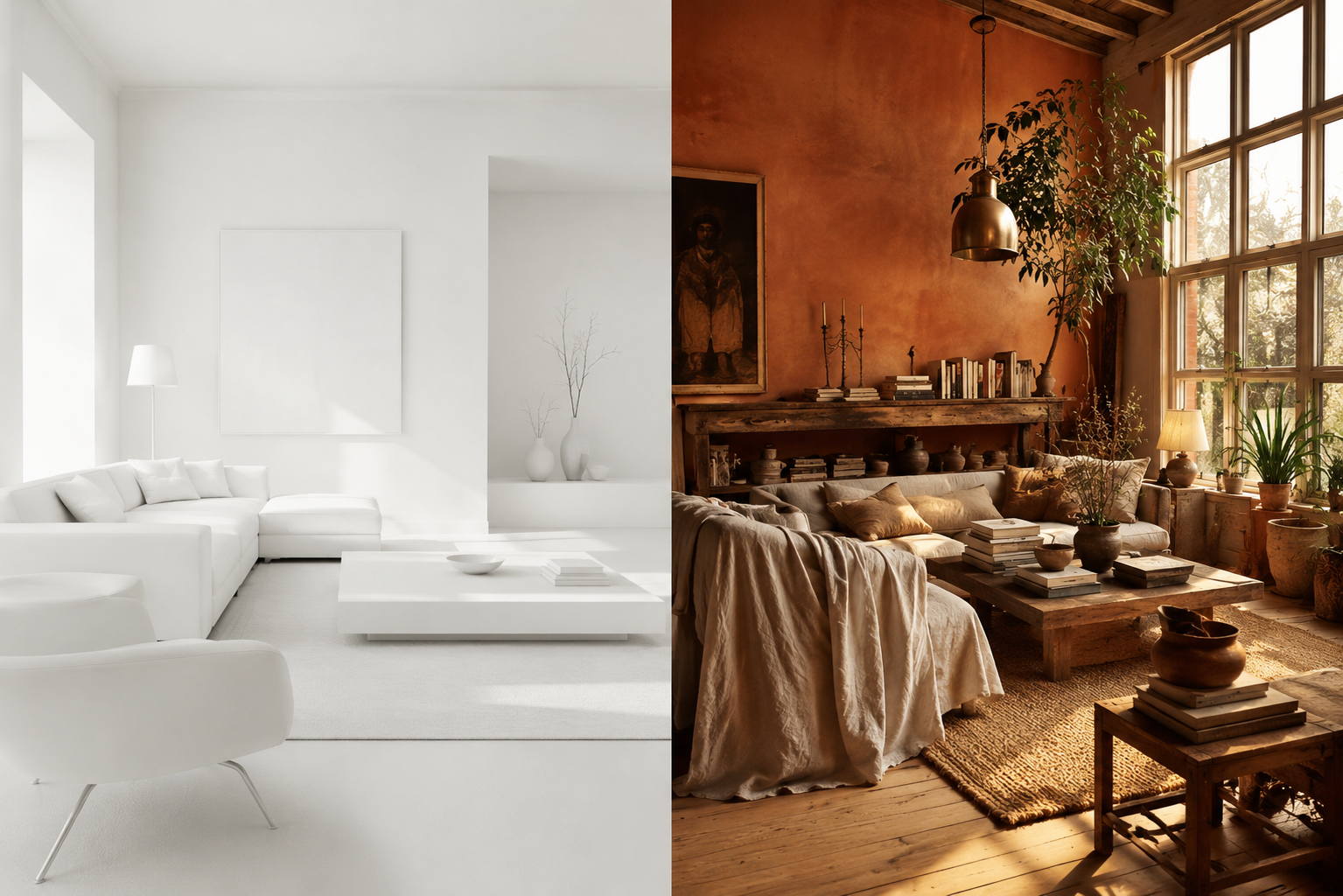
For roughly a decade, a very specific aesthetic dominated both social media and, by extension, the aspirations of design students everywhere. All-white walls. Barely-there furniture. Surfaces so empty they looked like they had never been touched by human hands. Everything photographed from the same three angles. Everything styled within an inch of its life.
It was a powerful look. It was also, increasingly, a lie.
Designers across the industry are now saying what many have thought privately for years. Brad Ramsey, Principal Designer at Brad Ramsey Interiors, put it plainly: design in 2026 is less about chasing a specific look and more about reflecting the people who inhabit the space. His colleague Danielle Balanis went further, saying that 2026 is about individuality and breaking the mold entirely.
The shift did not happen overnight. It happened because clients started noticing that the spaces they were pinning and saving and bringing to consultations did not actually feel good to live in. Ultra-white rooms looked cold by November. Minimal furniture left people with nowhere comfortable to sit. Surfaces styled for photography had nowhere to put a cup of tea.
One director at Sibyl Colefax and Fowler summed up the growing awareness perfectly: decorating should never be just for a photo. Imperfection, a little mess, and interiors that look like they were put together over many years are now considered genuinely attractive. The word that keeps appearing across every major design publication and trend report this year is the same one: lived-in.
What Lived-In Actually Means as a Design Skill
This is where it gets interesting for students, because lived-in is not a style. It is not a colour palette or a furniture category. It is a design philosophy, and it requires a completely different set of skills than producing a beautiful render.
Designing a space that feels lived-in means understanding how people actually inhabit rooms over time. Where do coats get dropped? Where do books accumulate? How does light change from morning to evening and how does the furniture need to respond to that? What happens to a white sofa in a house with children or dogs or a person who drinks red wine on Fridays?
These are not aesthetic questions. They are human questions. And the ability to answer them, to build those answers into a design before the client even moves in, is the skill that separates a good designer from one who only knows how to make things look good in a photograph.
The industry term for this right now is thoughtful maximalism, which is exactly as contradictory as it sounds. It means spaces that are full, layered, and expressive without tipping into chaos. It means knowing which statement piece earns its size, which textile adds warmth rather than noise, which piece of art was collected versus which was simply purchased to fill a wall. The goal, as Veranda described it, is spaces that are as transportive as they are inviting.
That word, transportive, is worth sitting with. A space that transports you somewhere is doing something a perfectly staged room almost never can. It has a perspective. It has a history. It feels like it belongs to someone.
What the Industry Is Actually Rewarding Now
The practical stakes of this shift matter enormously for anyone about to enter the job market.
Interior design graduates are entering one of the most competitive fields in the creative industry right now. The number of graduates has been growing faster than the number of available positions, which means employers have the luxury of being selective. And what they are selecting for has changed.
A portfolio full of flawless renders tells a hiring director that you can use software and that you understand basic spatial composition. Both of those things are necessary but neither of them is sufficient anymore. What reviewers are looking for now, and what genuinely rare in student portfolios, is evidence of design thinking rather than design styling.
Design thinking means showing your process. It means including the brief, the problem you were solving, the client's actual life you were designing around, and the decisions you made and why. It means demonstrating that you understand materiality, not just the way a material photographs but the way it ages, the way it feels underhand, the way it responds to humidity or sunlight or daily use.
It means being able to answer, confidently, the question: how does it live?
The Material Conversation Nobody Is Teaching You
One of the most significant shifts in 2026 interior design is the renewed emphasis on materials that age beautifully rather than materials that photograph well.
Honed stone over polished. Cork over lacquer. Reclaimed wood over pristine veneer. Hand-dyed textiles over digitally printed fabric. These are not nostalgic choices, they are intentional ones, made by designers who understand that a material with history already embedded in it requires less styling because it does its own storytelling.
Wimberly Interiors, one of the most respected hospitality design studios in the world, called this material honesty in their 2026 forecast. A preference for materials that patina and age gracefully, materials that show evidence of time and use rather than resisting it.
For students, this is a technical education as much as an aesthetic one. You need to know what happens to a raw brass fixture after two years in a bathroom. You need to understand the difference between how linen and polyester drape under natural light. You need to be able to tell a client why a terracotta tile floor will look better in ten years than it does on the day it is laid, and then actually be right about that.
This knowledge does not come from scrolling. It comes from touching, visiting, spending time in real spaces, and paying attention to what they do to you.
Biophilia Is Not a Trend, It Is a Framework
Every major design publication this year has included biophilia in its trend roundup, which has had the unfortunate effect of making it sound like something you either incorporate or ignore based on current taste. It is not.
Biophilic design, bringing nature into interior spaces through light, organic materials, living plants, water, and natural textures, is rooted in decades of environmental psychology research. The evidence that humans function better, think more clearly, and experience less stress in spaces connected to nature is not a Pinterest prediction. It is consistent across hundreds of peer-reviewed studies.
What is new in 2026 is not biophilia itself but its scope. It is no longer a finishing touch, a plant on a shelf, a natural fibre rug. It is becoming the foundational logic of how spaces are designed from the architectural level down. Large windows as a structural decision. Earthy palettes of terracotta, olive green, and clay as the baseline rather than the accent. Organic shapes in furniture that reference the irregularity of natural forms rather than the precision of manufactured ones.
For a design student, understanding the why behind biophilia, the actual human science of why it works, gives you something much more powerful than a trend to reference. It gives you an argument you can make to any client in any context.
The Portfolio Question You Should Be Asking Yourself
Before you present your next project, before you add it to your portfolio or share it anywhere, ask yourself one question honestly.
If I removed every piece of styling from this space, if I took away the perfectly arranged books and the single stem in the vase and the artfully folded throw, would the design still work? Would the spatial decisions still be sound? Would the materiality still make sense? Would the light still fall the way I intended?
If the answer is yes, you have designed a space. If the answer is no, you have styled a photograph.
The industry in 2026 is hiring designers. It has plenty of people who can style photographs. What it is genuinely short of, and what clients are increasingly demanding, are designers who understand how people live and can create spaces that serve that living rather than simply document it.
That is the skill worth developing. Not the render. Not the feed. The understanding.
Build spaces for lives, not for likes. The work that lasts has always known the difference.