
Why the Most Valuable Graphic Design Skill in 2026 Is Being Human
Here is something nobody tells you when you start studying graphic design: the hardest thing you will ever learn to do is make something look like it was not made perfectly.
That sounds like a joke. It is not. In 2026, the ability to design with intention and imperfection, to let something feel human rather than generated, is the single most in-demand skill across every corner of the industry. And it is genuinely difficult, because it runs against every instinct design education spends years building into you.
You spend months learning to kern type correctly, to align elements to the grid, to get your colours mathematically precise. And then the market turns around and tells you that the brands cutting through the noise right now are the ones with wobbly lines and scanned textures and typography that feels like it was hand-lettered at a kitchen table.
Understanding why that is happening, and what it actually requires of you as a designer, is the most important thing you can learn right now.
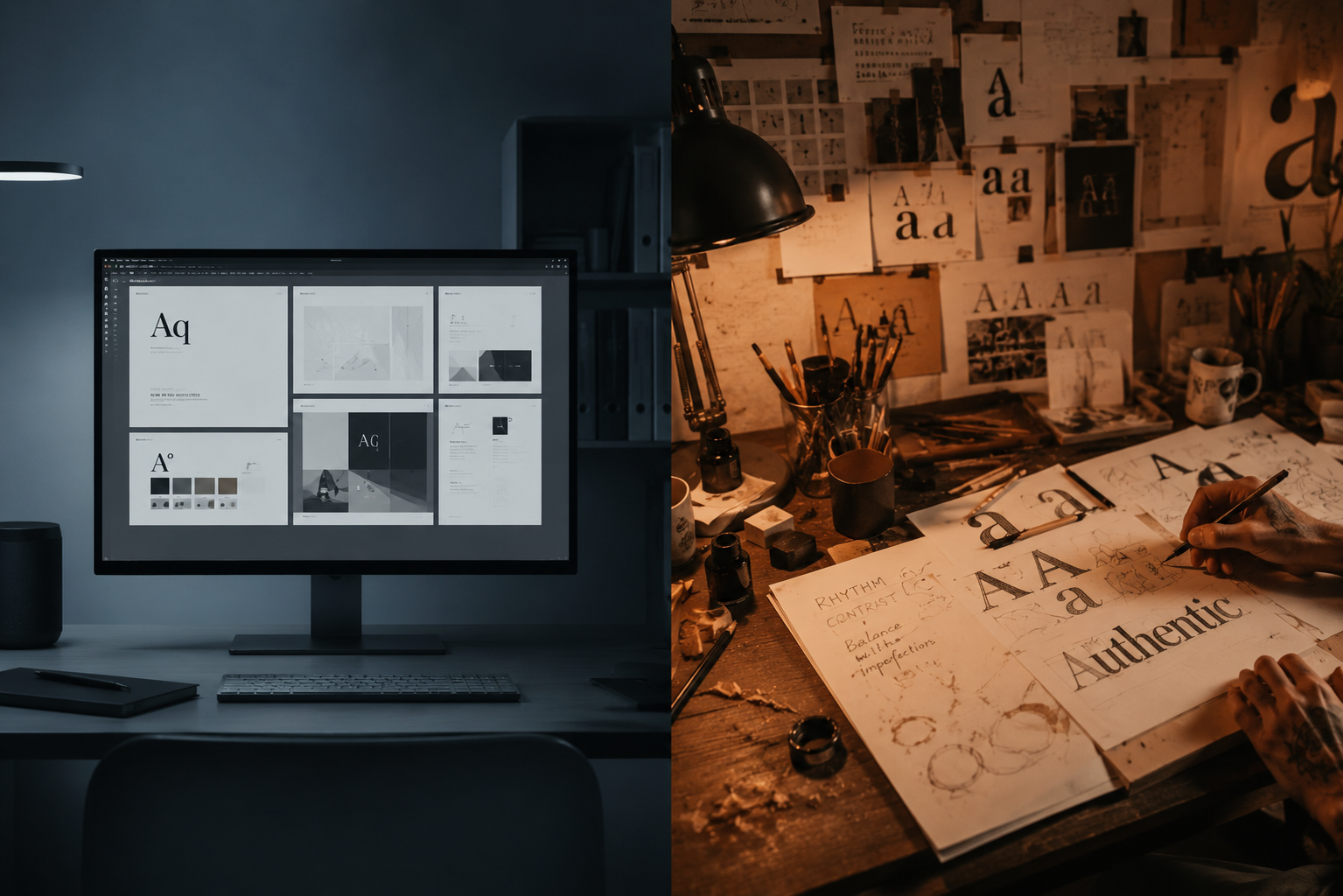
Why Perfection Stopped Working
Cast your mind back to 2019 or 2020. A clean sans-serif logo. A flat colour palette. A grid so tight it could have been measured with a ruler. That was the visual language of credibility. It said professional. It said modern. It said you knew what you were doing.
The problem is that AI learned to produce that exact aesthetic, flawlessly, in seconds. Midjourney, Adobe Firefly, Canva's AI tools — they all arrived having absorbed millions of examples of that precise style, and they can now generate it on demand for free. What once took a trained designer days to produce, an algorithm can replicate before you finish your morning coffee.
The result is a landscape saturated with perfect design. Every startup has a clean logo. Every Instagram feed has a coherent colour palette. Every pitch deck looks like it was made by the same invisible hand. And because of that saturation, audiences have developed an almost unconscious sensitivity to the difference between something a person made and something an algorithm produced.
Canva's own trend report named this year's dominant theme "Imperfect by Design." Research backs it up: 73% of consumers say they can identify AI-generated content, and they view it as less credible than work made by human hands. Hand-drawn elements, slightly off-kilter layouts, textures that feel like they were scanned from a real surface — these things stand out now precisely because they are increasingly rare.
One designer, Lily Andrews, put it in a way that should be on the wall of every design studio: "In a sea of AI-generated content, that human touch is your competitive moat."
What the Industry Is Actually Rewarding
The shift is showing up in hiring, in client briefs, and in the brands getting the most attention.
Pentagram, arguably the most respected design agency in the world, has been producing recent work that deliberately combines minimalist layouts with maximalist elements — quirky typography, hand-rendered details, visual friction that feels intentional rather than accidental. Oatly built an entire brand identity around type that looks crafted and imperfect, like it came from a person with a personality rather than a software preference. Burberry's recent serif refresh brought warmth and character back to a house that had gone almost too clean. The Whitney Museum's typographic identity is built around letterforms that carry voice and presence.
In each case the message is the same: design that feels like it came from a person who had a point of view is worth more than design that looks like it came from a brief fed into a machine.
For graphic design students, this creates an interesting and actually quite exciting career reality. AI has made average design abundant and cheap. Which means average design is no longer a viable career. What remains valuable is judgment, taste, and the ability to make something that could only have come from a specific human mind with a specific set of references and a specific way of seeing the world.
That is the skill worth developing. Not the ability to use the software — the software will always be learnable. The ability to have a design perspective that is genuinely yours.
The Typography Conversation
Typography is where the human rebellion against AI is most visible right now, and it is worth paying close attention to because type is the most powerful tool a graphic designer has.
In 2026, type is elastic. Letterforms stretch, soften, and flow. They suggest movement even in still compositions. Display type in particular is being used to carry emotion and tone rather than just legibility, and the most interesting work is happening in the space between a letter that is readable and a letter that is expressive.
The deeper principle here, and the one that connects to the broader human-touch conversation, is that typography is increasingly being treated as personality rather than communication infrastructure. As one creative director framed it, words are regaining cultural power. From activism to fashion to brand identity, language itself is becoming a visual statement, not just a vehicle for information.
What this means practically is that your typographic sensibility needs to go deeper than knowing which fonts pair well. You need to understand what a typeface communicates before a single word is read. You need to feel the difference between type that is cold and type that is warm, between type that dominates a layout and type that moves within it. That understanding cannot be downloaded. It develops through looking at a lot of type, handling a lot of briefs, and making a lot of mistakes in settings where mistakes are safe to make.
Which is exactly what you are in design school to do.
Tactile Design Is Not a Trend, It Is a Response
One of the most significant movements in graphic design right now goes by several names depending on who you ask: tactile design, textural design, anti-AI aesthetics. The common thread across all of them is a desire to make digital design feel like it has physical weight.
Surfaces that look like you could reach through the screen and touch them. Fabric-like backgrounds. Paper grain. Ink bleeds at the edges of type. Layouts that feel assembled by hand rather than constructed in software. The goal is to create a sensory experience through a medium that is inherently flat and intangible.
The psychology behind it is not complicated. Audiences have been trained by years of scrolling to process and discard digital content at extraordinary speed. A texture that suggests physical material slows that processing down. It creates a moment of pause, a sensation of weight and presence, that purely digital design almost never achieves.
This is not a passing aesthetic trend. It is a response to a structural condition of the digital environment that is not going away. If anything it will intensify as more and more content gets generated by AI with no human hand in the process at all. The work that feels made by a person will become more valuable, not less, as the ratio of human to generated content shifts further in AI's favour.
What AI Actually Changes About Your Job
This is the part of the conversation that creates the most anxiety among design students, and it deserves a straight answer.
AI is not replacing graphic designers. It is replacing a specific kind of graphic designer — the one whose primary value was technical execution of predictable visual styles. If your career plan was to produce clean, competent, trend-aligned work for clients who need it done quickly and cheaply, that lane is narrowing. That is the honest truth.
But the designers who are thriving right now are not the ones who refused to engage with AI tools. They are the ones who use those tools to handle the parts of the process that benefit from speed and iteration, and then bring human judgment, cultural awareness, and genuine creative perspective to the decisions that matter. The combination of AI efficiency and human taste is not a compromise. For the best designers working today, it is a competitive advantage.
The question you should be asking yourself is not whether AI will take your job. It is whether you are developing the kind of design thinking and personal aesthetic that no prompt could replicate. A strong point of view. A visual language that is recognisably yours. The ability to make decisions that reflect not just technical skill but genuine understanding of who you are designing for and why.
That is what clients will pay for in 2026. That is what employers are looking for in portfolios. And that is what design education, at its best, is in the business of building.
The One Practice That Changes Everything
There is a single habit that separates designers who develop a genuine visual identity from designers who remain technically competent but aesthetically anonymous: intentional looking.
Not scrolling. Not saving references to a folder you never open again. Actually looking at design, at art, at typography, at packaging, at book covers, at street signage, at the way a certain brand uses white space, and asking yourself specifically why something works or does not work. What decision was made here. What it communicates. What it would communicate if a single element changed.
This habit is unglamorous and it does not produce anything you can put in a portfolio immediately. But it is what builds taste over time, and taste is the thing that makes the difference between a designer who executes and a designer who thinks.
The most valuable graphic design skill in 2026 is looking human. But looking human starts with learning, slowly and deliberately, how to see.